Philly election results could predict how PA will vote in the 2022 primary
Volition Philly votes swing the land?
Philadelphia contains 20 per centum of the land's voters. An urban demographer charts what that means for the Presidential chief on April 28
January. 08, 2020


2020 is here. Finally.
While about eyes are on the Presidential race, the comparative advantage for my blog is going to be the state races. Can Democrats have back the Pennsylvania house? The Senate?
We'll get to all that when the time comes. But beginning, let's spend some time talking about the April 28 principal.
 By the time Pennsylvania votes, 34 states will accept already voted. There'due south a skilful chance the Democratic nominee will be clear past then. But we've had competitive primaries here before, and with so many candidates in the running there's a good chance no single candidate volition have locked up the endorsement.
On Election Nighttime, if it's close, optics will be focused on the Ballot Needle, especially now that we know it honest-to-goodness works. But the Needle is just built on Philadelphia returns. And I'm non going to try to procedure alive data from each of 67 counties.
When yous're watching the Needle, and information technology's certain who volition win the city, what can you say about the country? Is information technology possible to predict Pennsylvania'southward results knowing only Philadelphia's returns? Clearly Philadelphia is significantly more than urban and more liberal than the state as a whole, but within that we accept pockets of different voters. Could those blocs give us insights to the land equally a whole? Let's dig in.
Pennsylvania's voting bloc
The high-level strategy is to measure out how the rest of the land'southward counties correlates with Philadelphia'due south blocs. I employ the same SVD methodology that'due south behind the Needle. All of my land data comes from the Open Elections Projection.
We'll consider the elections from 2004 to 2018. To measure out the statewide correlations, we demand statewide races, so we'll limit the data to only Presidential and Gubernatorial races. And party primaries have entirely different correlations than generals, then we'll filter to simply competitive Democratic Primaries (excluding 2006 and 2018). The effect is that we have data on five elections. That's non great for understanding correlated random effects at the year level. But inside years we accept a lot of geographies, and within-twelvemonth patterns emerge.
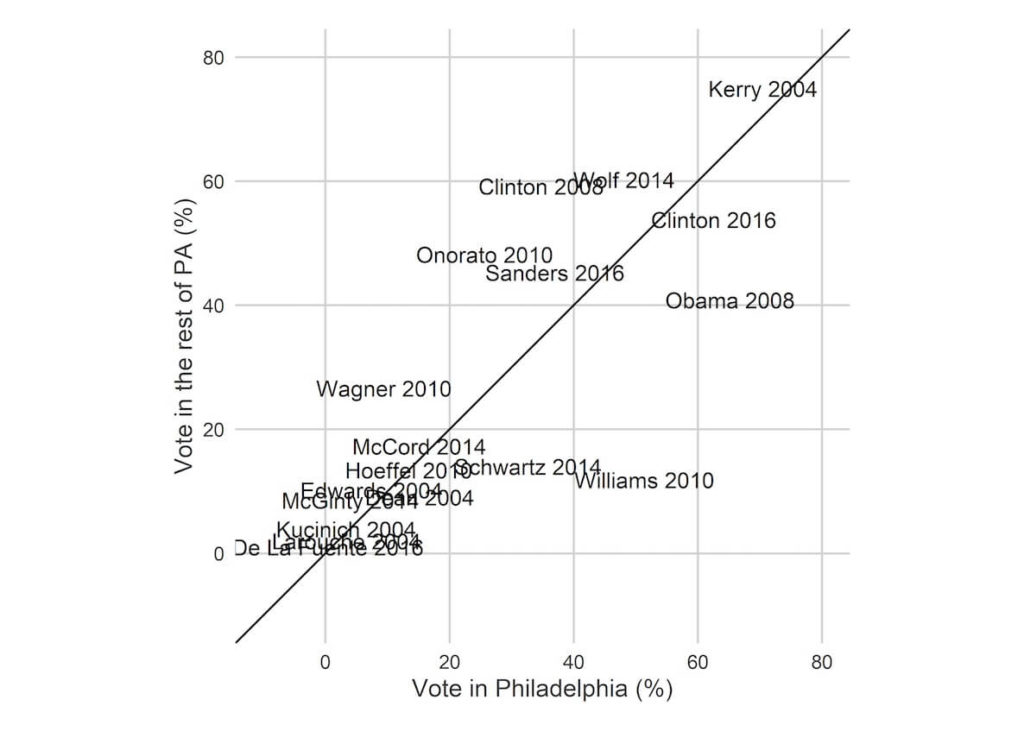
Philadelphia's results are broadly able to separate the candidates who are competitive in the rest of the state from those who aren't. Among competitive candidates, the correlations are weaker; Obama won Philadelphia in 2008 but lost PA, Williams won Philadelphia in 2010 merely Onorato won the state.
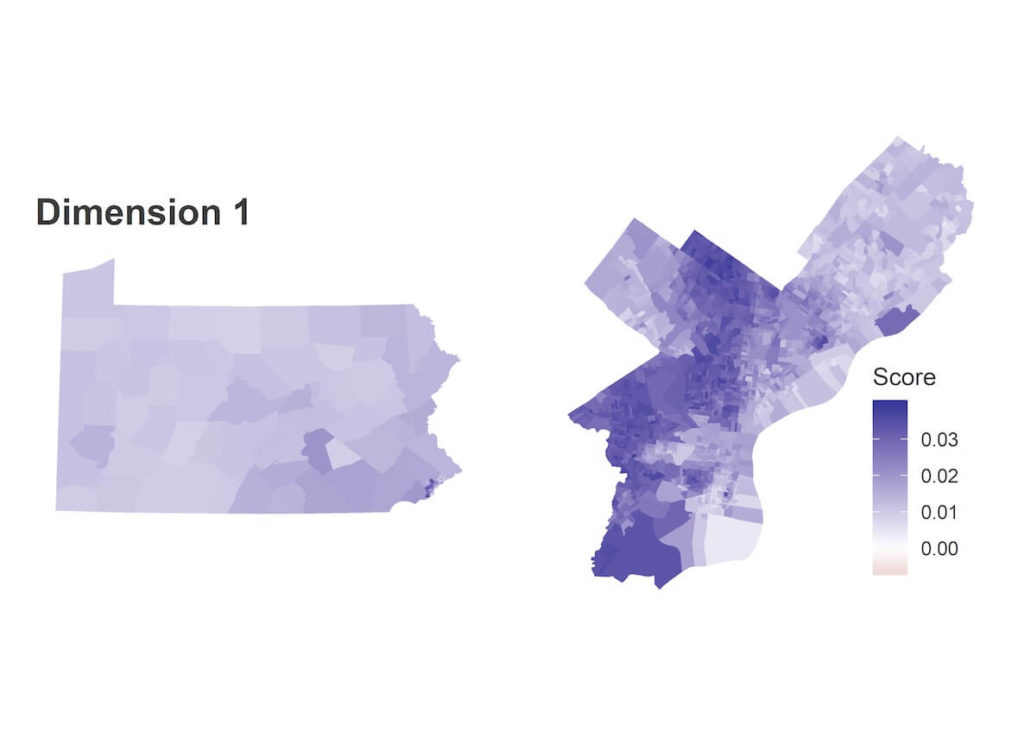
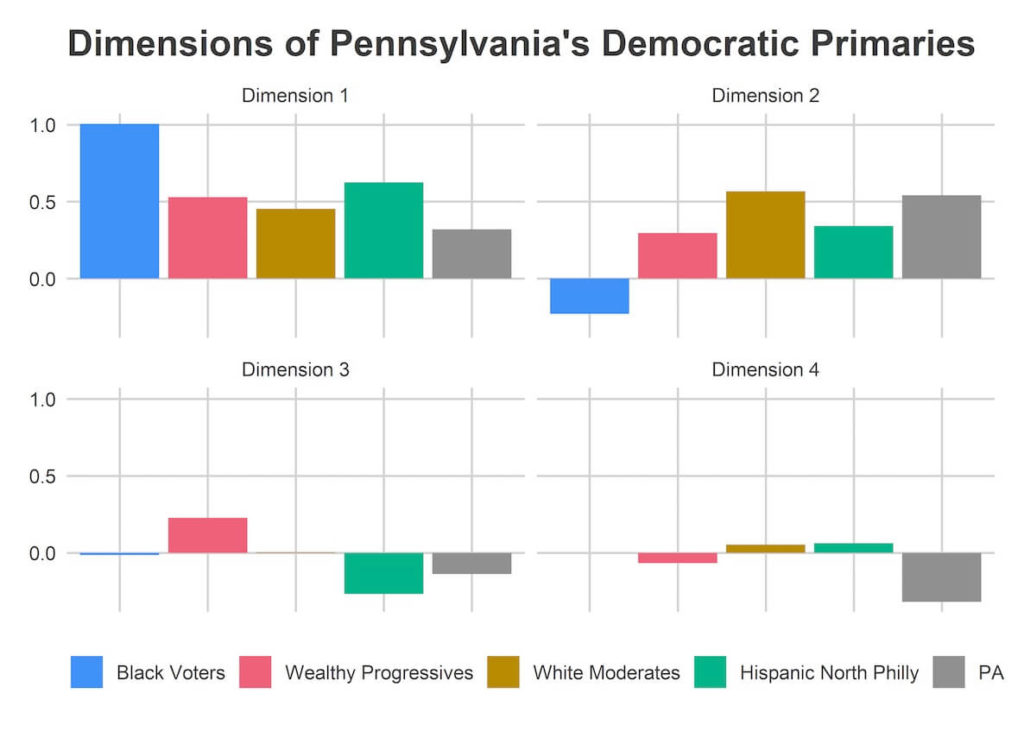
Dimension 1 is entirely bluish, meaning when a candidate does better in 1 place, they do amend everywhere. Only within Philadelphia, the Black divisions of West and North Philly swing more than for the popular candidates, and Southward-Eastern PA is swingier than the rest of the country. The table at the bottom of the post contains candidates' scores in each dimension. Kerry (2004), Williams (2010), and Clinton (2016) had the near positive scores in this dimension (idea Williams had a large Dimension 2 score, then "broadly popular" may not exist the right term).
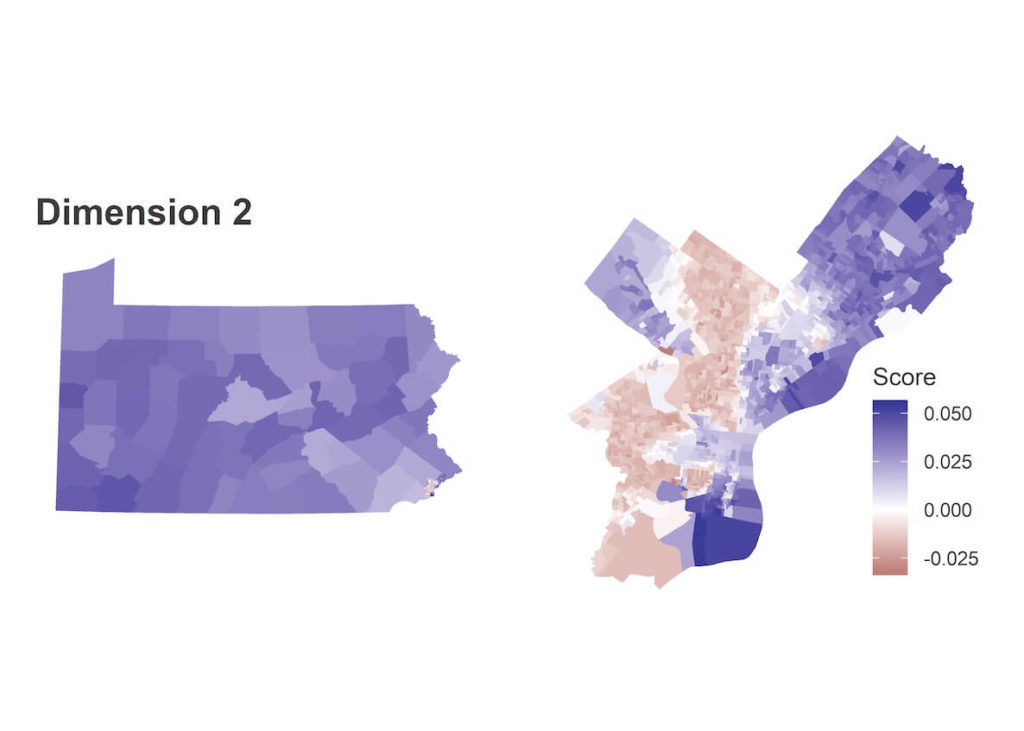
Dimension two identified Philadelphia's racial divide. Candidates who did disproportionately well in the red regions were Obama (2008) and Williams (2010), candidates who did better in the blue regions were Clinton (2008) and Kerry (2004).
The crimson Divisions are Philadelphia'southward Blackness divisions, and the nighttime blue are Philadelphia'south White Moderates. The rest of the state looks a lot like the white moderates along this dimension.
The Philadelphia suburbs, including Delaware and Chester counties, and State Higher'due south Eye Canton are only light blues, meaning closer to the middle. Recollect that this is simply amid Democratic Primaries, and so this is a split within the party, and not Democratic-Republican. Likewise, many of the other counties would have red precincts within them if I used inside-county measures instead of the canton averages. But not everyone has historical data as clean as Philadelphia's.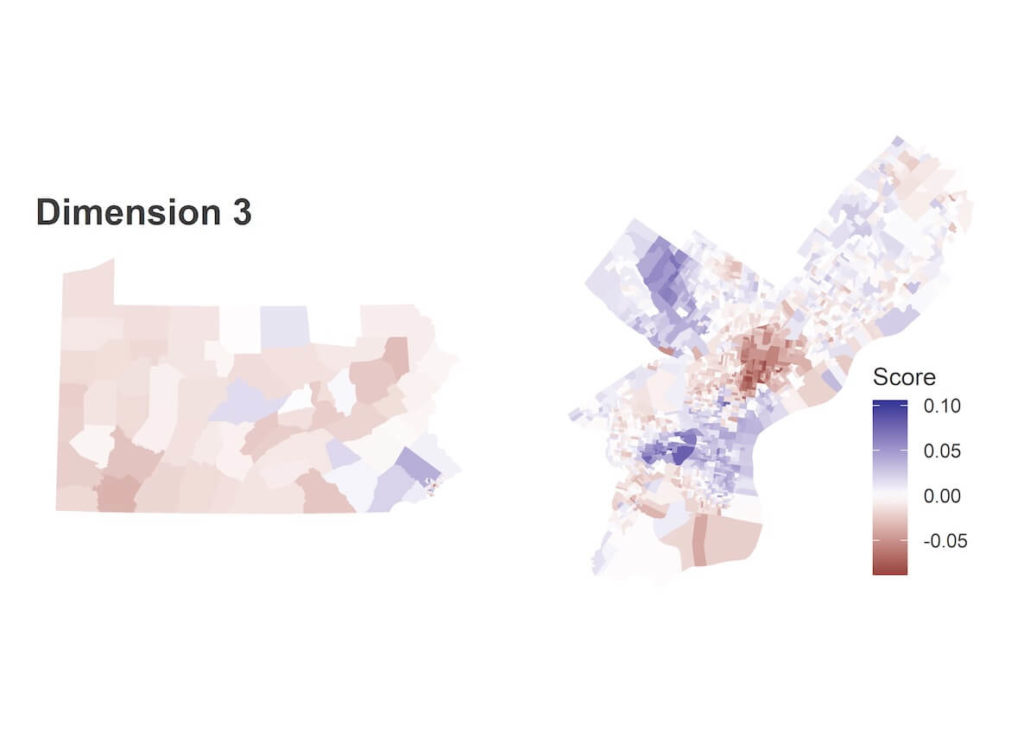
Dimension 3 finally introduces diversity in the rest of the state. Within Philadelphia, it divides the Wealthy Progressives (bluish) from Hispanic N Philly (red). In the residuum of the state, the Philadelphia suburbs and Centre County vote for similar candidates to the Wealthy Progressives, and the residue of Pennsylvania votes for like candidates to Hispanic N Philly (these are typically broadly popular candidates.) Candidates who did unduly well in the blue regions were Obama (2008) and Hoeffel (2010), candidates who did well in the red were Wolf (2014) and Clinton (2008 and 2016).
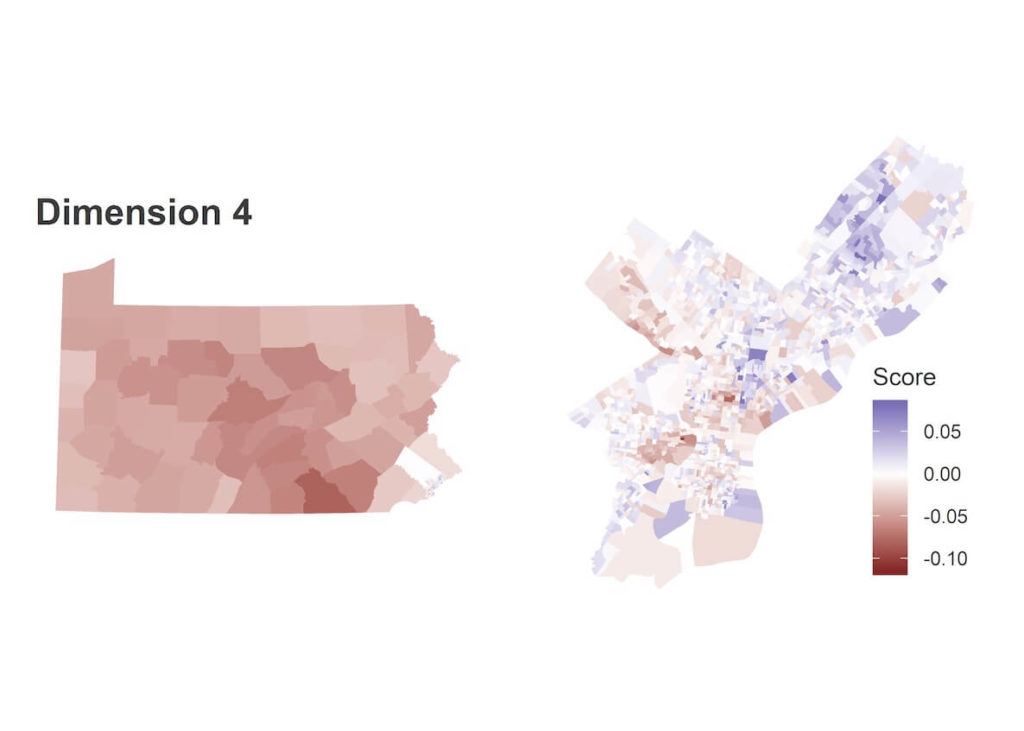
Dimension 4 looks similar dissonance within the city, but the rest of the state is deep ruby. It basically identifies candidates that split the state into Philadelphia versus everyone else. Wolf (2014) and Sanders (2016) have especially negative scores, and did disproportionately well in the residuum of the land.
The below bar plot and candidate table illustrates the relationship between Philadelphia'due south blocs and the rest of the state. To get a candidate's predicted percent, y'all would accept the candidate'due south scores in each dimension, multiply past the region's score, and sum beyond dimensions. So candidates with negative scores in a dimension practise amend in regions with negative scores in that dimension, and vice versa.
The equation to predict the rest of the state
So, the balance of PA looks a lot like Philadelphia'south White Moderate divisions in all dimensions merely Dimension 4. How should we amass up Philadelphia'south votes on election night?
I'll use a totally dissimilar methodology that reassuringly gives qualitatively like intuition. Allow'due south backslide a candidate's vote in the balance of the state on the vote coming out of Philadelphia's blocs.
 Nosotros don't have a ton of races. Worse, within each twelvemonth candidates' results are correlated with each other. This all means I don't accept much faith in the standard errors of the estimates. But at a high level, the results seem sane. Treat this like a rule of pollex, rather than rigorous analysis.
To predict the vote in the balance of the country, the formula is
Pct(Rest of PA) = 0.75 * Pct(White Moderates) + 0.33 * Pct(Wealthy Progressives) – 0.08 * Pct(Black Voters).
Candidates who do improve in Philadelphia's Blackness divisions actually do worse in the rest of the state, property constant their results in the Whiter divisions.
Philadelphia accounts for about xx percent of the land'due south votes in the Democratic Primary, so we add in those votes to get the combined results of Philadelphia plus the rest of the state (using the proportions that Philadelphia'due south turnout is 53 per centum Black Voters, 20 per centum Wealthy Progressives, 23 percent White Moderates, 4 per centum Hispanic North Philly).
Percentage(State-Wide) = 0.65 * Pct(White Moderates) + 0.30 * Percentage(Wealthy Progressives) + 0.04 * Pct(Black Voters) + 0.01 * Pct(Hispanic N Philly)
Jonathan Tannen is an urban demographer who operates the blog threescore-six wards, where this analysis originally appeared.
Header photo courtesy City of Philadelphia 
Source: https://thephiladelphiacitizen.org/primary-2020-prediction-pennsylvania/
0 Response to "Philly election results could predict how PA will vote in the 2022 primary"
Post a Comment